State Preemption Reaches the Mid-Atlantic
How Virginia's HB 711 overrides county solar bans — and why Maryland, Illinois, and Ohio map the fault line. The permitting decision still lives at the county board. But for the first time in the region, the state is rewriting what that board is allowed to decide.
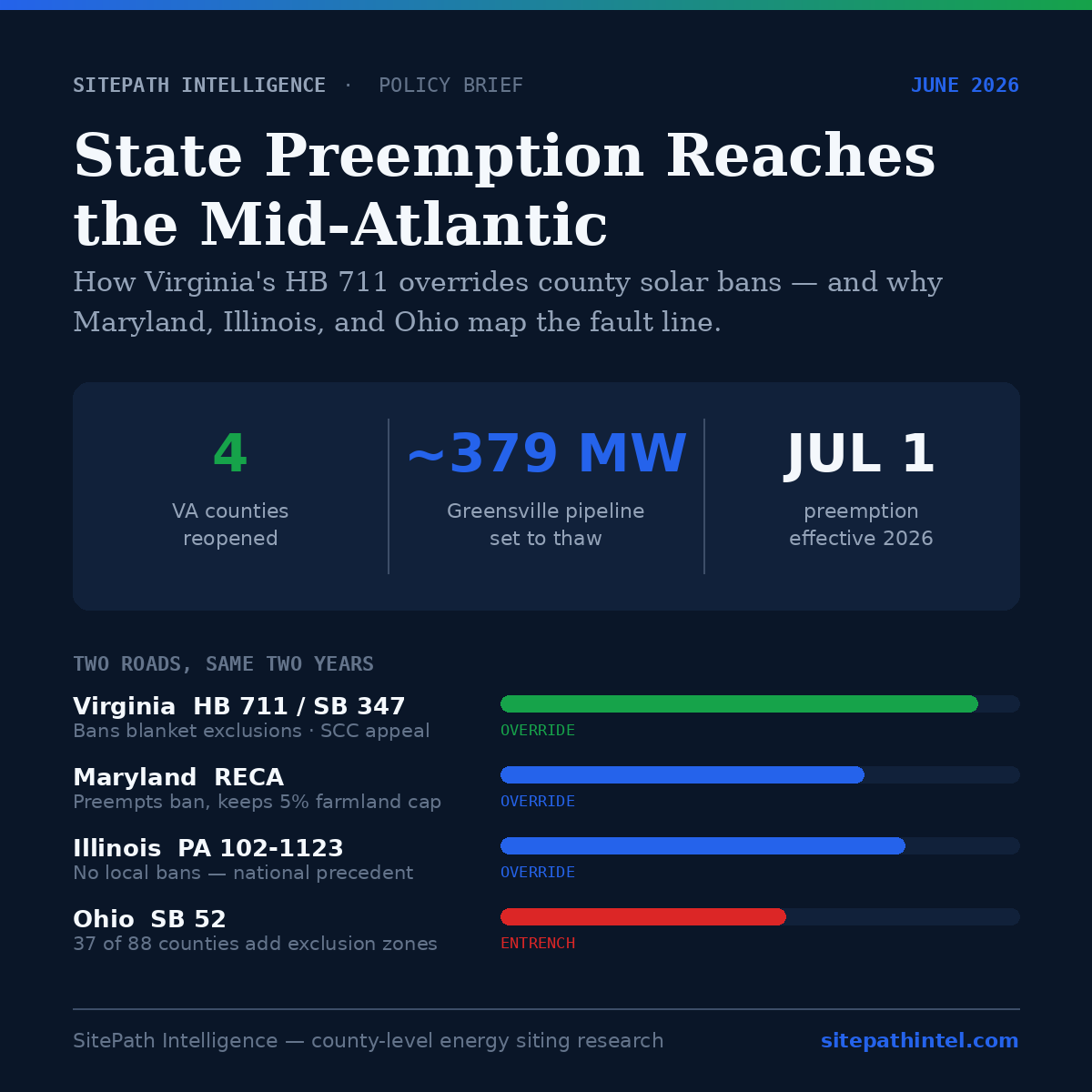
reopened by HB 711
set to thaw
2026
siting restrictions (2025)
The action has always been local — that part hasn't changed
For three years, the most important fact about utility-scale solar in the United States has been that the action is local. State energy policy — renewable portfolio standards, governors' targets, party control of the statehouse — turned out to be a poor predictor of where projects actually get built. SitePath's own state rankings make the point bluntly: Texas, with no active RPS mandate since it met its capacity target in 2009, posts the best median county permitting score in the country, while West Virginia, also without a meaningful RPS, ranks last. The permitting decision lives at the county board, not the governor's desk. See the state rankings →
That is still true. But on April 13, 2026, Virginia did something that complicates the story — and a handful of Mid-Atlantic states are doing versions of the same thing. The new dynamic worth watching is not whether states preempt local solar authority, but how they do it, and what each model leaves intact. The Mid-Atlantic is now the clearest laboratory in the country for that question.
What Virginia actually did
Governor Glenn Youngkin signed HB 711 / SB 347 on April 13, 2026, effective July 1, 2026 — the most significant shift in Virginia solar siting authority since the Virginia Clean Economy Act. The law does four things:
1. It prohibits outright bans and blanket exclusions on solar facilities of 1 MW or more in agricultural, commercial, industrial, or institutional zoning districts. Counties that had voted to remove utility-scale solar from their list of allowable uses must now accept and process applications.
2. It creates a Virginia Solar Energy and Energy Storage Siting Advisory Board to review projects over 20 MW within seven miles of an interconnection point, with a 90-day window to issue an opinion.
3. It requires a locality to approve or deny within 30 days of receiving that opinion.
4. It lets developers appeal a denial to the State Corporation Commission within 21 days; the SCC must approve within 30 days if the project meets specified capacity and proximity thresholds.
Sources are primary: Canary Media's reporting that Virginia's new law blocks counties from banning solar, the Virginia Association of Counties summary, and the codified text at Virginia Code § 15.2-2288.7. Opposition came from county governments and the Virginia Farm Bureau — the same coalition that drove the bans the law now overrides.
The county that turns the law into a test case
Greensville County is where the abstraction becomes concrete. In June 2024 the Greensville Board of Supervisors voted to remove utility-scale solar from its zoning ordinance entirely (Resolution 24-55), freezing roughly 379 MW of pipeline and earning the county an F grade with a 94.0 risk score. Greensville is the only Virginia county that appears on SitePath's national moratorium tracker — "an outlier in the Southeast," as the tracker puts it, since most Virginia counties have not moved toward moratoria despite active opposition elsewhere. See the moratorium tracker →
Under HB 711, Greensville's removal-from-use becomes illegal on July 1, 2026. SitePath's county profile already flags the consequence: the moratorium and removal becomes illegal; a pending zoning text amendment cannot create a ban; the pipeline may thaw. The law explicitly names Greensville, Patrick, Franklin, and Page as the counties with blanket bans that must now accept applications. One statute, four reopened markets, a frozen pipeline that may move — that is what state preemption looks like when it lands on a real county.
Virginia is not acting alone — and the models differ
The reason this is a trend and not a one-state story is that the Mid-Atlantic is converging on preemption from several directions at once, each with a different design.
Maryland got there first. The Renewable Energy Certainty Act (RECA, HB 1036) took effect June 1, 2025 — also partial preemption, but built around farmland rather than zoning category: it caps ground-mounted solar at 5% of acreage inside designated Priority Preservation Areas. A follow-on bill, HB 460, would cut that cap from 5% to 2%, which county officials estimate would eliminate one-third to one-half of currently solar-eligible PPA acreage, with the Maryland Association of Counties brokering the fight. Maryland preempts the ban but hands back a cap.
Illinois is the national precedent both states are echoing. Public Act 102-1123, signed January 27, 2023, prohibited counties from banning or enacting moratoriums on wind and solar and set a statewide setback floor; an Illinois appellate decision on August 1, 2025 sharpened the line between prohibited "exclusionary zoning" and permitted "reasonable operational limitations." That distinction — ban illegal, conditions legal — is exactly the seam Virginia and Maryland are now operating in.
Why it matters now: the wave it is pushing against
Preemption is arriving precisely because local restriction has become a mass phenomenon. By the end of 2024, at least 459 counties and municipalities across 44 states had adopted severe local restrictions on siting renewables, and the same survey identifies 498 contested projects across 49 states — renewable projects of every kind, not solar alone (Sabin Center for Climate Change Law, Columbia Law School, Opposition to Renewable Energy Facilities in the United States: June 2025 Edition, 30 June 2025). The pressure has a federal tailwind on the farmland side: in August 2025 the USDA moved to block loan and grant support for solar on prime farmland under EO 14315. Preemption laws like Virginia's and Maryland's are the counter-move — states deciding that local vetoes, in aggregate, were closing too much of the map.
The demand context makes the stakes plain. The EIA projects a record 86 GW of new utility-scale capacity in 2026, with solar at 51% — 43.4 GW, a 60% jump over the prior year. Virginia sits inside PJM, where the transition interconnection queue has been pulled down to roughly 46 GW with all projects slated for processing by end of 2026. A thawing county pipeline only matters if the grid can absorb it — and in PJM, for the first time in years, the queue side of the equation is improving while data-center load (FERC directed PJM in December 2025 to write co-location rules for AI data centers paired with generators) pulls demand the other way.
What to watch
Virginia's own ranking is the tell. Today the state sits 43rd nationally with a median county score of 41.2 and only 53% of counties graded A or B — a "Favorable" policy tier that has not translated into permissive local outcomes. HB 711 is a direct test of whether state preemption can move a county-level median that state policy alone never did. If Greensville, Patrick, Franklin, and Page reopen and their pipelines clear, Virginia's number should improve from the bottom up — county by county, not by proclamation.
The honest caveat, and SitePath's standing position, is that none of this guarantees approval. Partial preemption removes the blanket no; it does not remove the case-by-case one. The developer's edge is still knowing which board, in which county, under which freshly rewritten rulebook, is actually going to vote yes. The map just changed in four Virginia counties. The next year of board votes will say whether the law changed the market or only the paperwork.
Sources
This brief draws only on data already in the SitePath platform. Underlying primary documents:
- Virginia HB 711 / SB 347 — Canary Media; VACo; Virginia Code § 15.2-2288.7
- Maryland RECA / HB 460 — MACo / Conduit Street
- Ohio SB 52 exclusion zones — Ohio Environmental Council
- Siting restrictions (459 localities, 44 states) — Sabin Center, Columbia Law School (2025)
- 2026 capacity additions — U.S. EIA
- PJM interconnection queue — PJM Inside Lines
- SitePath internal: state rankings, moratorium tracker, and the Greensville County (FIPS 51081) profile.
Needs verification (not asserted as fact above): post-July-1 outcomes in Greensville/Patrick/Franklin/Page; whether Maryland HB 460 advances; and the Virginia Siting Advisory Board's first opinions — none yet in SitePath data.